Why I Still Write Everything by Hand in 2026. On Slowing Down When Everything Else Speeds Up

About a year and a half ago, work got heavier. Not all at once, just gradually, the kind of accumulation you don't notice until you realise you're carrying it everywhere. Into evenings, into weekends, into the quiet moments that used to feel like mine.
I'd been journaling for six years before that. But around that point, it stopped being something I did out of habit. It became the thing that kept the noise from taking over.
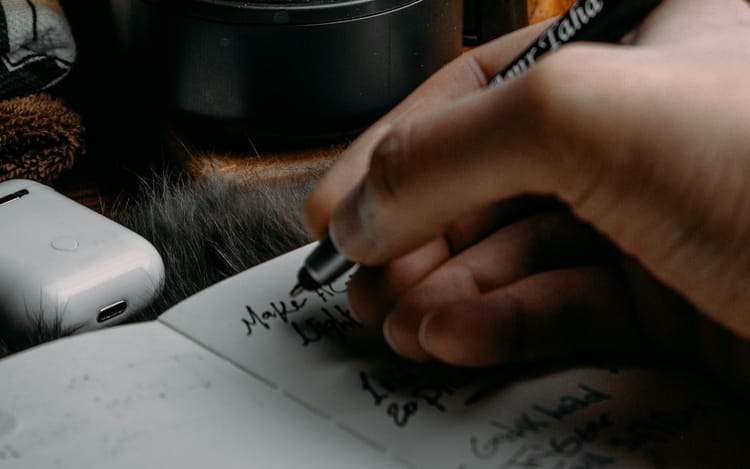
Somewhere in the middle of all that, I made a decision that feels small on paper and turned out to be larger than I expected: I stopped reaching for my phone or laptop first, and started writing everything by hand.
I'm still doing it. Here's why.
The case for fewer things done properly
Cal Newport's Slow Productivity makes an argument that sounds obvious until you actually sit with it.
"Do fewer things. Work at a natural pace. Obsess over quality."
What Newport is pushing back against is the idea that volume equals value, that the person juggling the most, responding the fastest, keeping the most plates in the air, is doing the best work. He isn't. And I think most of us already know this somewhere underneath the busyness.
I felt it long before I read it. The weeks where I tried to keep track of everything digitally, across apps and inboxes and shared documents, were the weeks I felt most occupied and did the least that actually mattered. The system expanded to hold whatever you threw at it. There was always more to add.
Paper doesn't do that. A Field Notes has forty-eight pages. When it's full, it's full. That constraint isn't a limitation, it's the point.
What writing by hand actually does to a thought
There's a book called Notebook: History of Thinking on Paper that traces the long lineage of people who wrote things down by hand in order to understand them. Scientists, philosophers, composers, writers. The notebook shows up across centuries not as a storage device but as a thinking tool: the place where the idea gets worked out, not just captured.
"The act of writing by hand forces the thought to slow to the pace of the hand. That slowing is not a limitation. It is the work."
When you type, you can outrun your thinking. Words appear faster than the ideas have fully formed, and you end up with a lot of words and less clarity than you started with. When you write by hand, the pen sets the pace. You think just slightly ahead of what you're writing, which means you're always one small step behind your own thought. That gap is where something real tends to happen.
I noticed this most on heavy days at work. If I tried to think through a difficult problem on a screen, I'd end up circling it for an hour without resolution. If I opened the A5 Leuchtturm instead and just wrote about it, I'd usually find the actual question within a page.
The setup I've landed on
Tools matter more than people admit, not because good tools make you write better, but because the right tools remove friction. If reaching for the notebook feels good, you reach for it more.
I wrote about the full setup recently if you want the details
 adrianhetman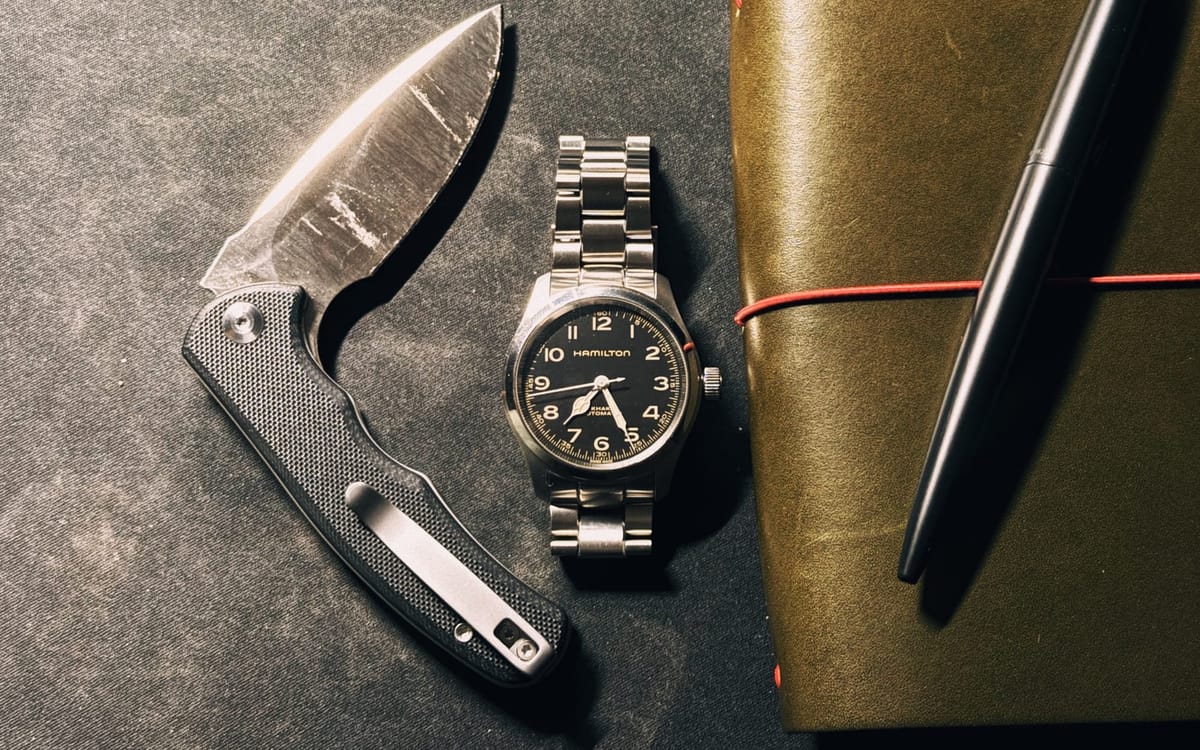
The short version is a Paper Republic Grand Voyager with four Field Notes refills, each doing one job: planning, journaling, the BuJo daily log, and collections. The pen at the moment is a Parker Jotter XL on a gel refill I'm testing. At home, the A5 Leuchtturm is where the free writing lives, the pages where I'm not trying to be useful, just honest.
What I've found is that splitting the notebooks by purpose removed the decision-making from the act of writing. I don't think about where to put something. I just reach for the right book.
Why it works when everything else doesn't
The real reason I still write by hand isn't productivity, though it does help me focus and figure out what actually matters on a given day. I wrote about that more directly in this article,
 adrianhetman
about how the journal isn't really a place to manage your task list but to question whether the tasks deserve to be there at all.
But underneath that, there's something simpler.
It keeps me present.
My daughter is three and a half. My second child is due within days of my writing this. The version of me who stays inside his own head all evening, running the same work thoughts in the background while physically in the room, is the version I've been working to leave behind.
Writing by hand creates a real transition. When I close the notebook at the end of the workday, something genuinely closes with it. The thoughts have been put somewhere. They're on the page, not still orbiting.
"Reclaim time before you lose it. Don't wait for a quieter season to start living deliberately."
Seneca said that. And he was right. The quieter season doesn't come. What comes is more of this: more responsibility, more presence required, more moments that ask something of you. The question is just whether you're actually there for them.
I won't tell you writing by hand solved everything. I'm still figuring out the longer-range planning, still working on the discipline of setting a clear intention the evening before and actually following it the next morning. The practice is solid. The follow-through is what I'm still building.
But the notebook has stayed constant across everything else that has changed: different jobs, a career pivot, a daughter, a second child on the way. Eight years in and it's still the first thing I reach for when I need to think clearly.
It works because it's slow by design. And slow, right now, is exactly what I need.
This week, try starting one morning on paper instead of a screen. No apps, no inbox, just a notebook and just start writing whatever is sitting on your mind.
See you soon.


Member discussion