The Courage to Stop Caring What Your Setup Looks Like

There is a version of analog living that exists entirely for other people.
The perfectly arranged desk. The fountain pen resting at an exact angle. The journal spread that took forty minutes to set up before anything got written in it. The watch photographed on a leather strap against aged wood. It's everywhere, and it's beautiful, and it has almost nothing to do with actually using any of it.
I've been guilty of it. Not the photographs, but the underlying impulse: the quiet awareness of an imaginary observer watching how I do things, and adjusting accordingly.
A book I read recently put a name to where that impulse comes from, and it changed how I think about the whole practice.
What Adler understood about other people's opinions

The Courage to Be Disliked is built on the psychology of Alfred Adler, and one of its central ideas is deceptively simple: most of what makes us anxious is not about the thing itself, but about how we imagine we appear while doing it.
Adler called this "the desire for recognition." The need to be seen a certain way. To be approved of. And his argument was that as long as your actions are oriented towards earning that approval, you are not really living your own life. You are performing it.
"If you are not living your life for yourself, then who is living it?"
That question sounds abstract until you apply it to something small. Like the way you set up your notebook in the morning. Or whether you feel slightly self-conscious pulling out a Field Notes while everyone around you has iPads and MacBooks open. Or why you have three notebooks you barely write in because they look serious on a shelf.
The functional version of everything
My bullet journal is not attractive. It's a Field Notes in a grid edition, tucked into a Paper Republic cover that's earned a few scratches. The handwriting is not calligraphic. There are crossings-out, arrows, tasks migrated and remigrated because I kept avoiding them. Some pages are half-empty. Some are cramped.
It works because it's used, not because it looks like anything.
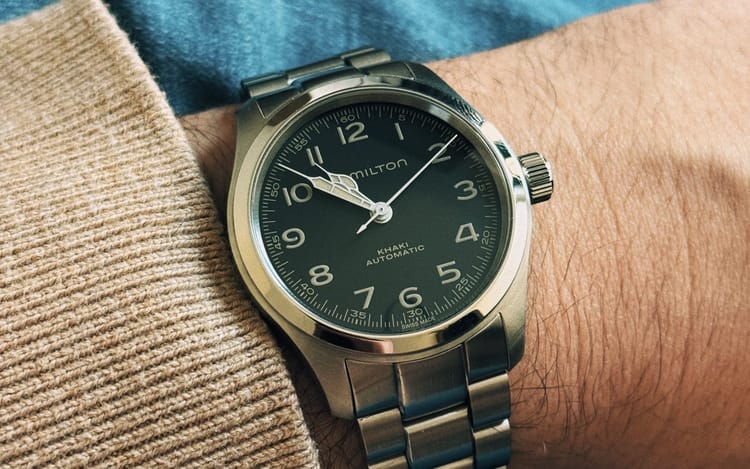
The watch on my wrist most days is a Hamilton Murph 38mm. I love it, but I didn't choose it to signal anything. On other days it's a Casio F91W or the G-Shock 5610U. They tell the time. They don't notify me of anything. That's the whole job.
None of this is an aesthetic position. It's a practical one. The moment I started choosing tools for what they do rather than what they communicate, everything got simpler and I actually used the things I owned.
Doing it for yourself

I'll be honest about something. In the early days of journaling, I did think about how the notebook would look if someone saw it. Not in a dramatic way, just that low hum of self-consciousness that follows you into new habits before you're settled in them.
That passed. Eight years in, nobody else enters the picture when I open the journal. But a subtler version of it has crossed my mind more times than I'd like to admit: hesitating mid-entry, aware that what I'm writing doesn't reflect well on me, even though nobody will ever read it. The imaginary observer had followed me into the one space that should be entirely private.
Writing around what you actually think because some phantom version of your own conscience is sitting across the table, that's the version worth watching for. It's quieter than performing for others, and harder to catch.
The Adler idea is a useful frame here, but you don't need the philosophy to feel what it's pointing at. Most people who've kept a journal for any length of time know the difference between an entry that's honest and one that's been written with half an eye on how it reads. The honest ones are the ones that actually help.
The rest is just more noise dressed up as reflection.
What changes when you stop

When the self-consciousness drops away, a few things shift.
You stop acquiring tools you won't use and start using the ones you have. The A5 Leuchtturm on my desk at home is not the most beautiful journal available. It is the one I have been opening long enough to trust it.
You stop performing the practice and start doing it. There is a difference between writing in a journal and writing in a journal while being aware that you are the kind of person who writes in journals. The first one is useful. The second is a subtle performance, even with no audience present.
And you start noticing when the tools are actually working, rather than when they merely look like they should.
Not perfectly, and not without the occasional drift back toward aesthetics over function. But the practice that has stayed, the one that has genuinely helped me think more clearly, be more present, carry less noise around in my head, is the unglamorous one. The Field Notes with the bent cover. The pen that runs out at the wrong moment. The weekly review that's half a page of scrawl and one honest sentence.
You don't need a better setup
The thing that stops people from journaling, from keeping a bullet journal, from wearing the watch they actually like rather than the one they think they should, is almost never the absence of the right tools.
It's the belief that the right tools would make them the kind of person who does it properly.
That belief is a trick. A way of avoiding the task by placing a condition in front of it. I'll start when I have the right notebook. When I have time to do it well. When I have a setup worth photographing.
"Now is all we have. The courage to act on that is the whole practice."
The notebook you have is the right notebook. The pen you own is the right pen. The ten minutes before everyone else wakes up is the right time.
What would happen if you just started, without it looking like anything?
Open whatever notebook is nearest. Write one sentence about what's actually on your mind today. Not a beautiful sentence. Not the beginning of a system. Just the thing that's there.
See you soon.



Member discussion