How to Journal When You Don't Know What to Write
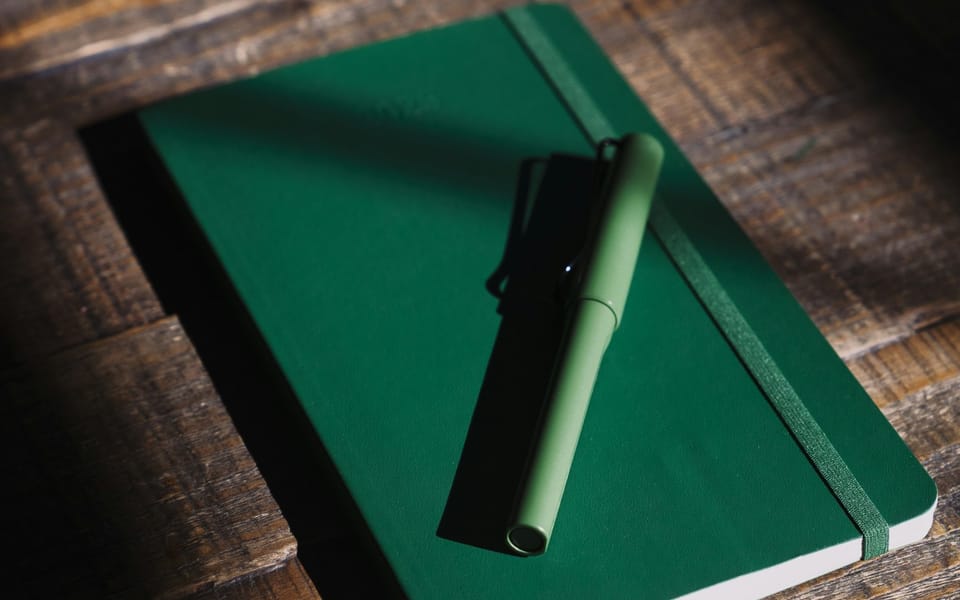
The blank page is not the problem. The belief that something worth writing needs to be waiting for you before you open the notebook, that is the problem.
I've been journaling for eight years. The blank page still shows up. Some mornings I sit down with the Field Notes and genuinely have no idea where to start. The week is fine, nothing is on fire, nothing particularly interesting has happened. The page just sits there.
What I've learned is that waiting for the right thing to write is the same as waiting for the right moment to start. It's a condition you've placed in front of a practice that doesn't actually require it.
You don't need something to say. You just need to start.
Why the blank page feels so final

Oliver Burkeman makes a point in Meditations for Mortals that stuck with me. The resistance we feel before doing something is almost never about the thing itself. It's about the story we've attached to it. That we need to be in the right headspace. That it needs to go well. That a half-formed entry doesn't count.
"Doing something imperfectly today beats waiting for the perfect conditions that never arrive."
The journal doesn't require perfect conditions. It doesn't require anything, actually, except that you open it and write something. The value isn't in the quality of what comes out. It's in the act of externalising whatever is loosely orbiting in your head, even if that thing is nothing much.
James Clear makes a related point in Atomic Habits. The most important thing about a habit in its early stages is not how well you do it, it's that you do it at all. A two-minute entry that feels like nothing is still a two-minute entry. It still happened. The practice was kept alive.
That framing helped me on the days when the notebook felt like a test I hadn't prepared for.
What to write when nothing comes
Here are the things I reach for when the page is blank and I have nothing obvious to put on it.
Write what's in front of you right now. Not metaphorically. Literally. The coffee cooling beside you. The sound from the next room. The quality of the light. The mind follows the hand, and the hand needs somewhere to start.
Write the thing you've been avoiding thinking about. There's usually something. It might be small, an unanswered message, a decision you've been circling, something someone said last week that didn't fully land. The fact that you haven't written about it yet is often the reason it's still there.
Write a question rather than an answer. You don't need to resolve anything in a journal entry. Ryder Carroll's Bullet Journal Method frames the journal as a place for reflection, not resolution. Sometimes the most useful entry is a single honest question you haven't let yourself ask properly yet.
Write what you'd say if nobody would read it. This one sounds obvious but it's where most of the useful material is. The entry that's slightly more honest than comfortable. The admission that something isn't working. The thing you know but haven't said out loud yet, even to yourself.
Write about what you noticed today. Not what happened. What you actually noticed. The specific thing your kid or spouse said. The moment in a meeting that felt off. The thought that appeared on your walk and then disappeared before you caught it. Small observations, written down, have a way of connecting to larger ones.
The five-minute rule

Make Time by Jake Knapp and John Zeratsky is a book about choosing a single daily highlight, one thing that deserves your full attention. The journaling equivalent is simpler. Choose one prompt, give it five minutes, and stop.
Not because five minutes is the ideal length. Because the constraint removes the performance pressure. Five minutes is achievable on any day, in any headspace. It's enough to get something real onto the page without requiring you to have your thoughts in order first.
I've had five-minute entries that were more useful than thirty-minute ones. The limit forces you to go straight to the thing rather than warming up around it.
What the practice is actually for
The point of journaling on the days when you don't know what to write is not to produce a good entry. It's to maintain the habit of checking in with yourself at all.
Most of the noise that builds up across a week, the low-level anxiety, the half-formed worry, the decision you haven't made, lives below the surface not because it's deeply buried but because you haven't looked at it directly. Writing forces the look. Even a messy, uncertain, going-nowhere entry does that.
James Allen wrote in As a Man Thinketh that the mind is like a garden. It produces whatever you give your attention to, whether deliberately or not. The journal is one of the few places where you get to decide what gets your attention, at least for a few minutes.
That's worth protecting, even on the days when it feels like there's nothing to say.
A place to start today

If you're reading this with a notebook nearby and no idea what to write, here is one prompt to start with.
Write down the thing that's been at the back of your mind this week, the one you keep not quite thinking about. One sentence is enough. You don't have to go further than that unless something opens up.
Most of the time, it does.
Open the notebook. Write one sentence. See what's there.
See you soon.



Member discussion